Used Snap-on Tools
The tool-truck brand that holds its value better than almost anything else in a mechanic's box — which is exactly why the used market is so active, and why it attracts fakes.
📈 Current listings pulled: $15 – $7,500 • Updated September 5, 2026
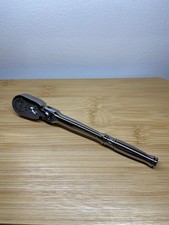
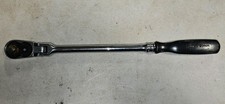
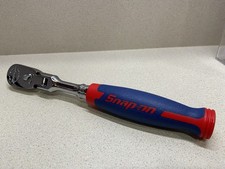
The most-traded Snap-on item on eBay. The 3/8" FH80 flex-head and F80 fixed-head are the ones you'll see constantly; the 1/4" T72 and 1/2" S80 less often. A used 80-tooth ratchet with a crisp click and no back-drag is worth paying for. One with mushy engagement needs a rebuild kit — factor that in.
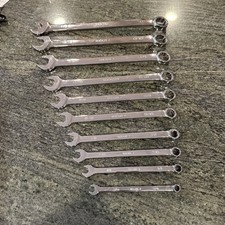
Look for OEX (SAE) and OEXM (metric) combination wrenches and the SOEX Flank Drive Plus line. Individual wrenches from broken sets are the best value on eBay — sellers price them to move, and you can rebuild a full set over a few months for well under new-set cost.
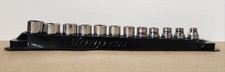
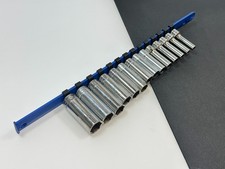
Check that set listings actually include every size before bidding — "complete" sets are often missing the 10mm or the 1/2". Loose 3/8" FS (shallow) and SFS (deep) sockets are plentiful and cheap; 1/2" impact sockets less so.
Why used Snap-on is different from used anything else
Snap-on doesn't sell through hardware stores. Since the company's early days in Milwaukee in the 1920s, its hand tools have gone out almost entirely through franchise dealers driving dedicated tool trucks to shops, on weekly routes, on credit. That sales model is why a Snap-on ratchet costs what it costs new — you're paying for the truck, the dealer's route, and the financing — and it's why the used market is so lively. The tool itself was never the expensive part.
It's also why used Snap-on holds value. The buyer pool is mechanics who already know exactly what an FH80 is, what it should feel like, and what the truck wants for it. That keeps prices firm. You will not find a working Snap-on ratchet on eBay for hardware-store money. What you will find is a tool that's been made in the company's Wisconsin plants for decades with a design that barely changes, sold at 40–60% of truck price by a retiring tech or a shop clearing out a box.
One more thing that's specific to this brand: the resale market has a counterfeit problem. Because the logo carries so much value, there is a steady supply of fake ratchets and wrench sets on eBay, mostly from overseas sellers. Most of this page is about how to tell the difference.
Reading Snap-on part numbers
Snap-on part numbers are terse but consistent, and once you know the prefixes you can search eBay for exactly what you want instead of scrolling through everything with the logo on it. The first letter usually tells you the drive size:
| Prefix | Means | Common examples |
|---|
| T | 1/4" drive | T72, TH72 (ratchets); TM (metric sockets) |
| F | 3/8" drive | F80, FH80, FHL80 (ratchets); FS/FSM (shallow sockets); SFS/SFSM (deep) |
| S | 1/2" drive | S80, SH80, SL80 (ratchets); SW/SWM (sockets) |
| L | 3/4" drive | L72 series |
| OEX / OEXM | Combination wrench, SAE / metric | OEX16 (1/2"), OEXM10 (10mm) |
| SOEX / SOEXM | Flank Drive Plus combination wrench | The "plus" version grips the flats, not the corners |
| KRA / KRL | Classic-series / Masters-series storage | KRA2422, KRL722 |
| CT / CDR | Cordless impact / cordless drill | CT8850, CT9080, CDR8850 |
The suffix letters matter too. On ratchets, H means flex head, L means long handle, and the number is the tooth count — 72 or 80 on current models, 36 on older ones. An M at the end of a socket or wrench number means metric. So "FHL80" reads as: 3/8" drive, flex head, long handle, 80 teeth. That's a more useful eBay search than "Snap-on ratchet."
Snap-on's numbering has exceptions, especially on older tools and specialty items. Treat the table as a starting point, not a rulebook.
Date codes and what they tell you
Most Snap-on hand tools carry a small date code stamped near the part number — historically a letter, later a symbol or a two-character code. Collectors have compiled charts that map these to production years, and they're worth a look if you want to know whether that ratchet is from 1985 or 2015.
For a buyer, the date code matters for two practical reasons. First, older 36-tooth ratchets feel different from the current 80-tooth ones — coarser action, wider swing arc — and some people prefer them, some don't. Second, and more importantly: a "Snap-on" tool with no date code at all is a red flag. Genuine forged tools have it. Counterfeits frequently don't, or have one that's laser-etched rather than stamped.
The warranty question, honestly
This is the thing people most want to know before buying used Snap-on, and the honest answer has two layers.
Snap-on's published hand-tool warranty is a lifetime warranty against defects in materials and workmanship. In practice, franchise dealers have a long-standing habit of swapping a broken genuine ratchet or wrench for whoever hands it to them on the truck, without asking for a receipt. That's the reputation, and it's mostly earned. But it is dealer discretion, not a written promise to the second owner — and it doesn't cover abuse (a wrench used as a hammer, a socket split by an impact gun it wasn't rated for). If the warranty is part of your buying math, treat it as likely rather than guaranteed.
Two things the lifetime warranty does not cover, and where used buyers get surprised:
- Power tools, torque wrenches, and diagnostic equipment carry shorter limited warranties, typically a year on the tool and often less on batteries. A used CT8850 impact is a used power tool — buy it as one.
- Blue-Point is Snap-on's second brand, sold off the same trucks. Much of it is made by other manufacturers to Snap-on's spec, and it carries a different, generally shorter warranty. It's good equipment, but it is not Snap-on, and it shouldn't be priced like Snap-on.
What to inspect before you bid
These are Snap-on-specific. General used-tool advice — check seller feedback, read the description — applies too, but you already know that.
- Ratchet action. Ask the seller whether it clicks cleanly through a full rotation with no skipping. Skipping means a worn pawl or gear. Rebuild kits exist and aren't expensive, but you should be paying a rebuild-needed price, not a working price.
- Plating. Snap-on chrome is thick and should be intact. Flaking or bubbling plating usually means the tool spent time in a wet box or a chemical bath. Still functional, but it's a negotiating point.
- The anvil on 1/2" ratchets. Look at the square drive. Rounded corners mean it's been overloaded. On a fixed-head S80 that's the whole tool.
- Wrench jaws. Open-end jaws on OEX wrenches should be square and unspread. A spread jaw was used on something too big or with a cheater bar.
- Roll cab slides and locks. On KRA/KRL boxes, ask specifically whether every drawer opens and closes on its own slide, and whether the lock works with a key present. Replacement slides are available but add up fast across a 12-drawer cab.
- Set completeness. Count the pieces in the photos against the set number's published contents. Missing sizes are common and sellers don't always mention them.
Spotting fakes
The counterfeit problem is concentrated in a few product types: 3/8" ratchets (especially FH80 lookalikes), combination wrench sets, and screwdriver sets. Roll cabs and individual sockets are rarely faked — not worth the effort. Tells that reliably separate genuine from fake:
- Logo application. On genuine forged tools the name is part of the forging or deeply stamped. Fakes are usually laser-etched or lightly printed and can look too clean.
- Missing or wrong date code. Covered above. This is the single most useful check.
- Price against the market. A "new" FH80 listed at a third of what used ones sell for is not a bargain. It's the tell.
- Seller pattern. A seller with dozens of brand-new Snap-on listings, all the same few part numbers, shipping from overseas, is not a retiring mechanic.
- Weight and finish. Genuine tools are heavier than they look and the chrome is mirror-smooth. Fakes are often lighter with a slightly grainy finish. Hard to judge from photos — ask for a close-up.
Where the value is
If you're building a box on a budget, the best ratio of Snap-on quality to eBay price is in individual tools from broken-up sets — single wrenches, single sockets, single screwdrivers. Sellers price these to clear, and buyers mostly want complete sets, so the singles sit. Rebuilding an OEX set one wrench at a time over a few months is tedious but ends up costing far less than either a used complete set or the truck.
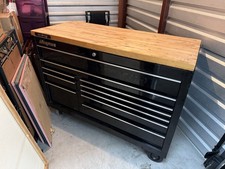
Roll cabs are the other place value hides, because they can't ship. A KRA cab listed as local pickup only has a buyer pool limited to a driving radius, and prices reflect that. If one turns up near you, it will usually be the cheapest way to get into Snap-on storage.
The worst value is usually complete "as new" sets from sellers with no history — for the reasons in the section above.
Common questions about used Snap-on
Will a Snap-on dealer honor the warranty on a tool I bought used?
Usually, for genuine hand tools. Most franchise dealers will exchange a broken ratchet or wrench regardless of who bought it originally — but it's their call, it excludes abuse, and it doesn't extend to power tools, torque wrenches, or Blue-Point items. Don't pay a premium on the assumption it's guaranteed.
Is Blue-Point the same as Snap-on?
No. Blue-Point is Snap-on's secondary line, sold off the same trucks, much of it made by other manufacturers to Snap-on's specifications. It's decent equipment with a shorter warranty, and it should be priced well below the equivalent Snap-on item on the used market.
What's the difference between an F80 and an FH80?
Both are 3/8"-drive, 80-tooth ratchets. The F80 has a fixed head; the FH80 has a flex head that pivots to reach around obstructions. The FH80 is the more popular one and shows up on eBay more often. An FHL80 is the same ratchet with a longer handle.
Other tool-truck and pro brands
Listings shown are pulled from eBay and refreshed periodically. Prices and availability change constantly — click through for current details. As an eBay Partner Network Affiliate, we may earn a commission at no additional cost to you.